
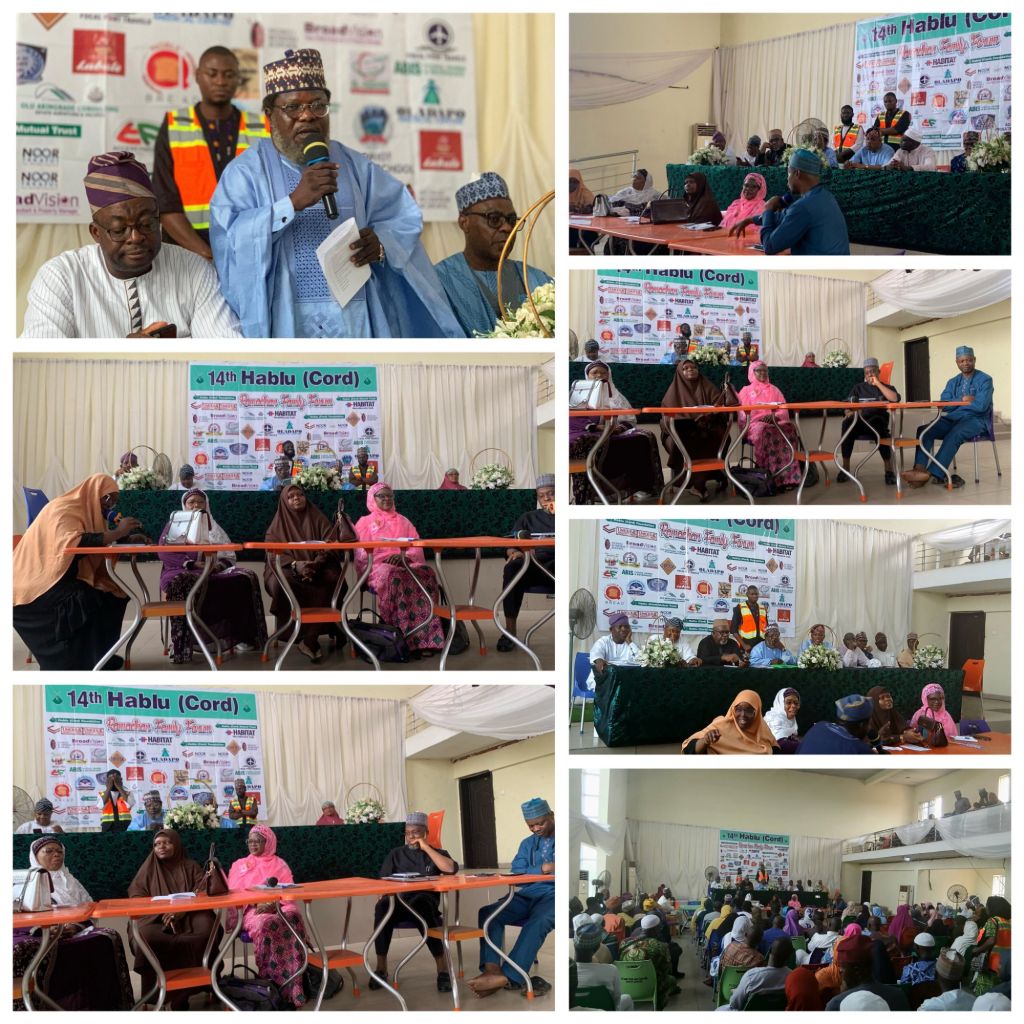
The 15th Annual Ramadan Family Interactive Forum of Hablu Cord Foundation focused on two critical issues affecting Muslim families, under the theme “When Marriages Falter”. Yesterday, March 2nd, 2025, the forum featured two thought-provoking discussions: “Where Realities Differ from Expectations”, which explored the challenges of managing marital expectations, and “Biology of Poverty”, which examined the far-reaching effects of poverty on family dynamics.
Sheikh Daud Adelakun emphasized the importance of managing expectations in marriage, highlighting the disparity between idealized partners and reality.
The forum’s first session, “Where Expectations Differ from Reality,” explored strategies for coping with the differences between anticipated and actual marital experiences. Sheikh Adelakun posed poignant questions, encouraging attendees to reflect on their own expectations and those of their partners.
A second session, “Biology of Poverty,” examined the psychological, social, and nutritional effects of poverty on families. Sheikh Adelakun stressed the need to mitigate these effects using cost-effective means to provide nutritious food.
He emphasized the value of open conversation and shared experiences. He encouraged attendees to participate actively, sharing their insights and learning from one another.
In his stewardship report, Sheikh Adelakun highlighted Hablu Cord Charitable Foundation’s interventions and outreach activities over the past year. These included:
– Forty cases of divorce interventions out of which, alhamdulillah, thirty two cases were fully reconciled. Eight are currently pending out of which three are looking highly reconciliable.
– Ninety Eight cases of family disputes interventions including inheritance, drug and alcohol abuse, women battery, violence etc. These are almost a daily occurrence.
– Fifteen widows resettled and assisted with orphans.
– Fifteen widows resettlement in progress.
– Forty five successful matchmaking.
– One hundred and five matchmaking in progress.
– We have had the largest number of singles, widows/widower, divorcee matchmaking partly due to our “Idílé Musulumi” Radio Program.
– Our self sponsored Radio program “Idílé Musulumi” has been running for the past three years on Radio Lagos 107.5FM every Thursday 9:30-10 PM. We did run some episodes on Eko FM English Edition
During the first panel discussions Dr. Ogunmuyiwa Sulaimon emphasized the importance of self-awareness and proper preparation before entering into marriage. He advised individuals to detach their marital expectations from the experiences of their parents, as each marriage is unique and requires a deep understanding of one’s partner.
“When you are going into marriage, forget about the experience of your parents. You are not marrying either of them; you are marrying a different person. So, understand yourself,” he said.
The cleric stressed that many people enter marriage without first understanding themselves, which can lead to challenges in the relationship. He urged individuals to engage in deep self-reflection before making such a lifelong commitment.
“We need to do a lot of self-awareness before we go into marriage. Ask yourself: What are my critical needs? These are the fundamental things that must be discussed before marriage to avoid unnecessary conflicts over petty matters.”
He further highlighted the importance of pre-marital counseling, where a neutral, experienced third party can facilitate meaningful discussions. According to him, couples might not always provide honest or complete answers when questioning each other directly, but a professional counselor can help uncover crucial insights.
“Engage in pre-marital counseling, where an experienced professional will serve as a mediator, asking important questions that may not come up in regular conversations. This ensures that both partners gain clarity and make informed decisions before entering into marriage.”
Alhaja Ibrahim Hanifat lecturer discussed the importance of patience and understanding in marriage, highlighting that no one can have everything they desire in a marital union.
Reflecting on her own experiences, she shared that during her early years, she was not exposed to certain realities about marriage. However, with time and increased exposure, she came to understand that marriage requires a level of maturity and adaptability.
“During my time, I wasn’t exposed to many things related to marriage, but as time went on, I faced the reality of life. The more exposure you have, the more you realize that marriage isn’t about perfection but about compromise and understanding.”
Her message was clear: patience is a fundamental ingredient in navigating the ups and downs of married life. She urged couples to cultivate patience in their relationships, as challenges are inevitable, and how they handle them determines the strength of their union.
“In marriage, challenges will arise, but patience is key to resolving them. Without patience, small issues can escalate, creating unnecessary conflicts. Couples must learn to manage their expectations and handle issues with wisdom and emotional control.”
Coach Aishat Adetula highlighted the critical role of pre-marital counseling in ensuring a stable and successful marriage. She pointed out that a major issue affecting many marriages today is the lack of proper guidance before couples enter into the union.
“Pre-marital counseling is one of the major factors affecting marriage, yet we lack it. The only form of counseling most people receive is from their parents and relatives. When issues arise, we turn to Allah in prayers, which is essential, but if the problem is an environmental factor, we need to re-strategize, refine our approach, and focus on what is necessary.”
She cautioned against allowing emotions to cloud judgment, emphasizing that emotional impulsiveness can prevent individuals from finding effective solutions to marital challenges. According to her, marital affairs come with both minor and major issues, and addressing the minor problems early on can prevent them from escalating into major crises.
“In Islam, Allah places a huge responsibility on women to be resilient. Take, for example, the common saying that men are polygamous by nature. While this may be difficult to accept, women must acknowledge this reality and find a way to move forward rather than reacting emotionally. Failing to do so may lead to undesirable consequences, such as seeking the same path and ending up bringing illegitimate children into the world.”
Dr. Jubril Salaudeen addressed the issue of poverty, categorizing it into three types: Active Poor, Handicap Poor, and the Poorest of the Poor, with the latter being trapped in intergenerational poverty; a cycle where financial struggles are inherited.
“Poverty is not just about lack of money; it is a cycle that must be broken through knowledge and action,” he said.
He highlighted alarming statistics, stating that 18.3 million children are out of school due to poverty, with 80% of them being Muslims. Additionally, one in three Nigerian children experiences severe financial and food deprivation caused by insecurity, migration, and lack of resources.
Beyond education, he noted that poverty has also impacted marriages, with Nigeria’s divorce rate rising to 20–26% in the last four years, largely due to financial hardship.
“The economy mirrors the divorce rate. Financial struggles are a major cause of broken homes,” he emphasized.
Despite Muslims being among the wealthiest globally, he pointed out that many still struggle due to poor financial literacy and mismanagement.
“We do not lack resources, but we lack strategic wealth management. Money is a sophisticated tool that must be handled wisely,” he said.
To prevent financial instability, he stressed the importance of long-term investment and financial planning, warning that mid-life crises often stem from poor financial decisions earlier in life.
“Many men face hardship in their fifties because they failed to plan for sustainability. Wealth is not just about accumulation but longevity,” he added.
In conclusion, he urged the audience to prioritize financial literacy, invest wisely, and take deliberate steps to break the poverty cycle.
“If we truly want to escape poverty, we must be intentional about our financial choices,” he said.
 ajasainfo.com
Leave a Reply