
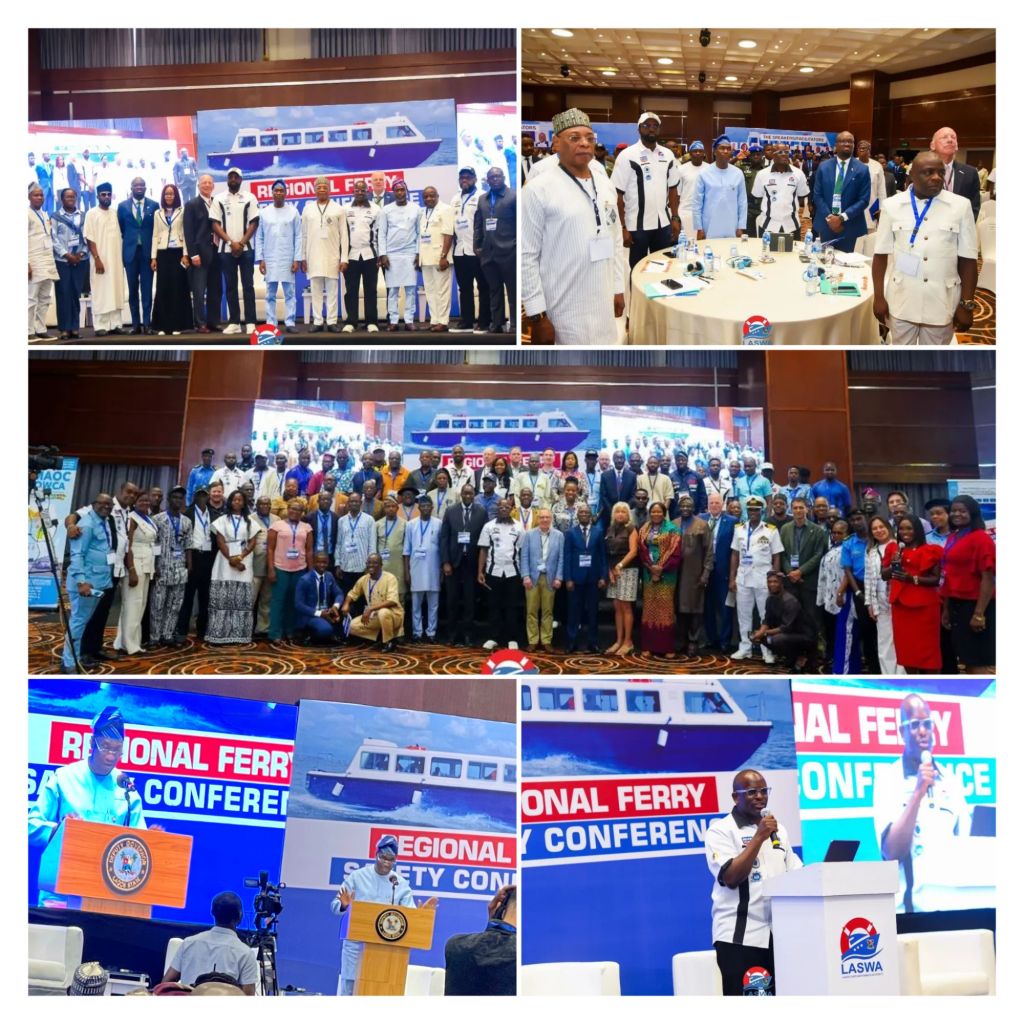
The 2025 Regional Safety Conference on Ferry Transport Systems in Africa kicked off in Lagos, Nigeria, with a call for unified regional efforts to tackle ferry safety challenges. The conference, themed “Charting Safer Waters: Advancing Ferry Safety Through Innovation, Collaboration, and Integrated Transport Solutions,” brought together policymakers, ferry operators, regulatory bodies, community advocates, and international partners.
Governor Babajide Sanwo-Olu represented by the Deputy Governor Dr. Kadri Obafemi Hamzat, emphasized the importance of unified regional efforts to tackle ferry safety challenges and commended LASWA for spearheading the initiative alongside MOWCA and INTERFERRY.
The Deputy Governor highlighted Lagos State’s investments in modernizing its water transportation system, including the construction of modern jetties and ferry terminals, deployment of patrol and rescue boats, and establishment of the Inland Waterways Monitoring and Data Management Centre. He also noted the introduction of stricter operational guidelines and the locally-built Omi Bus standard ferries to enhance regional capabilities.
However, the Deputy Governor stressed that ferry safety is a regional imperative that transcends local boundaries. He called for common safety frameworks, shared data and intelligence, standardized training protocols, and adoption of innovative technologies to elevate navigation and emergency response. The Deputy Governor emphasized the need for partnerships, policy alignment, and actionable solutions to create a lasting impact.
In a notable statement, the Deputy Governor urged the National Inland Waterways Authority (NIWA) to stop issuing licenses to individuals engaged in sand filling on Lagos waterways. He advocated for expanding water transportation and allowing the waterways to breathe, highlighting the importance of sustainable development.
The conference provided a platform for stakeholders to discuss critical issues affecting ferry safety and explore solutions to promote efficient, accessible, and safe water transportation in the region. The Deputy Governor’s speech underscored Lagos State’s commitment to leading the way in creating a safer and more sustainable ferry transportation system.
Mr. Damilola Emmanuel, General Manager of the Lagos State Waterways Authority (LASWA), emphasized the importance of collaboration, innovation, and community inclusion in building a safer and more resilient ferry transport system across Africa’s waterways.
He highlighted the conference’s objectives, including harmonizing policies and establishing robust regional frameworks for safer cross-border ferry operations. He also emphasized the need to elevate technical and design standards to ensure infrastructure readiness for future needs and position ferry transport as a vital component of urban and regional mobility.
The General Manager noted that LASWA is committed to working with partners to achieve these goals.
The conference features high-level panels and roundtable discussions on policy alignment, technical standard-setting, and regulatory frameworks. Mr. Emmanuel encouraged participants to engage fully in these discussions and share their expertise and experiences. He also invited participants to attend technical workshops on design, vessel safety, innovation, and digital monitoring technologies.
He expressed gratitude to the Governor of Lagos State for his visionary leadership, particularly in developing waterways transportation in Lagos State. He also thanked MOWCA for their steadfast commitment to safety and growth throughout West and Central Africa and INTERFERRY for sharing their invaluable global insights and perspectives. Mr. Emmanuel appreciated the dedication of his LASWA team members and the Commissioner of Transportation for their support.
As the conference progresses, Mr. Emmanuel encouraged participants to take advantage of opportunities for networking and collaboration with international partners and investors. He emphasized that the conference aims to forge a safer, more resilient future for ferry transport across Africa’s magnificent waterways and coastal regions, promoting sustainable coastal development and Africa’s blue economy.
The Commissioner for Transportation, Lagos State, Oluwaseun Osiyemi highlighted the importance of water transportation in urban transit systems, particularly in coastal cities experiencing rapid population growth. He noted that ferry services have become a necessity, and safety has emerged as a critical concern. In Lagos, the state has invested in terminals and jetties, digital monitoring systems, and strict safety protocols to ensure safe water transport.
The Commissioner emphasized that maritime safety is a continuous journey that demands collaboration, innovation, and vigilance. He called for collective action to raise safety standards and ensure that every passenger boards a ferry with confidence. Osiyemi expressed gratitude to co-hosts and partners, including the Maritime Organization of West and Central Africa (MOWCA) and INTERFERRY, for their commitment to regional safety cooperation.
Osiyemi commended the Lagos State Waterways Authority (LASWA) for its pivotal role in fostering dialogue on ferry safety. He urged participants to transform discussions into policies, frameworks, and impactful changes on waterways. The Commissioner reaffirmed Lagos State’s pledge to be a leader and partner in maritime safety and development, calling for collective action to sail forward with safety and purpose.
The Nigeria Transportation Commissioners Forum (NTCF) emphasized the importance of collaborative efforts to unlock the full potential of water transportation in Nigeria and the region. Mrs. Chinwe, representing Engr. Gbenga Dairo, Chairman of NTCF, made this call, as the NTCF believes that through strategic planning and collaboration, a world-class water transportation system can be established across the region.
The NTCF highlighted the vital role of water transportation in facilitating freight, reducing transportation costs, and promoting economic growth. However, the sector faces challenges, including infrastructural deficits and regulatory hurdles. The forum commended the organizers of the Regional Ferry Safety Conference for bringing together key stakeholders to discuss the future of water transportation.
The Maritime Organization of West and Central Africa (MOWCA) Secretary General, Dr. Paul Adalikwu, emphasized the importance of ensuring ferry transport safety, highlighting that millions of commuters rely on ferry services daily. He recalled the 2024 Regional Workshop on Safety of Inland Waterway Transport and Ferry Accidents in Libreville, Gabon, which produced the Libreville Plan of Action. This document will be discussed during the conference.
Dr. Adalikwu commended the Lagos State Government and the Lagos State Waterways Authority for hosting the conference, noting that Lagos’s robust water transport authority and multi-modal transport services make it an ideal location for the event.
Dr. Adalikwu thanked the Lagos State Government and the Lagos State Water Authority management for taking on the opportunity to host the conference, despite the short notice and lack of budgetary provision.
Mr. Tim Mooney, Chairman of INTERFERRY, emphasized the need for strategic investments in Lagos’ water transportation system during the Regional Ferry Safety Conference. Mooney noted that Lagos’ unique geography, surrounded by water, presents opportunities for growth and development.
According to Mooney, investments should focus on both capital and operational aspects to ensure the sustainability and competitiveness of ferry services. He highlighted the importance of finding a balance between pricing and ridership, noting that the price point needs to be attractive to commuters while also generating revenue.
As an outsider, Mooney expressed his admiration for Lagos’ potential and opportunities, stating that he was impressed by the city’s prospects. He thanked the organizers for inviting INTERFERRY to participate in the conference and expressed willingness to collaborate and provide support.
Mr. Bola Oyebamiji, Managing Director of NIWA, represented by the Head of Marine, Elsie Egwuatu The National Inland Waterways Authority (NIWA) reiterated its commitment to promoting safer and more efficient inland water transportation across Nigeria’s vast 10,000-kilometre waterways network.
Egwuatu emphasized that ferry safety is a shared responsibility that requires the collective efforts of all stakeholders. She highlighted NIWA’s collaborative efforts with partners such as NASO, Agro-Water, and the Maritime Workers Union of Nigeria to enhance safety standards, improve emergency response protocols, and promote sustainable practices in water transport.
Egwuatu urged stakeholders to continue working together to build safer and more sustainable waterways that will benefit not only passengers but also the communities that depend on water transport.
 ajasainfo.com
Leave a Reply