
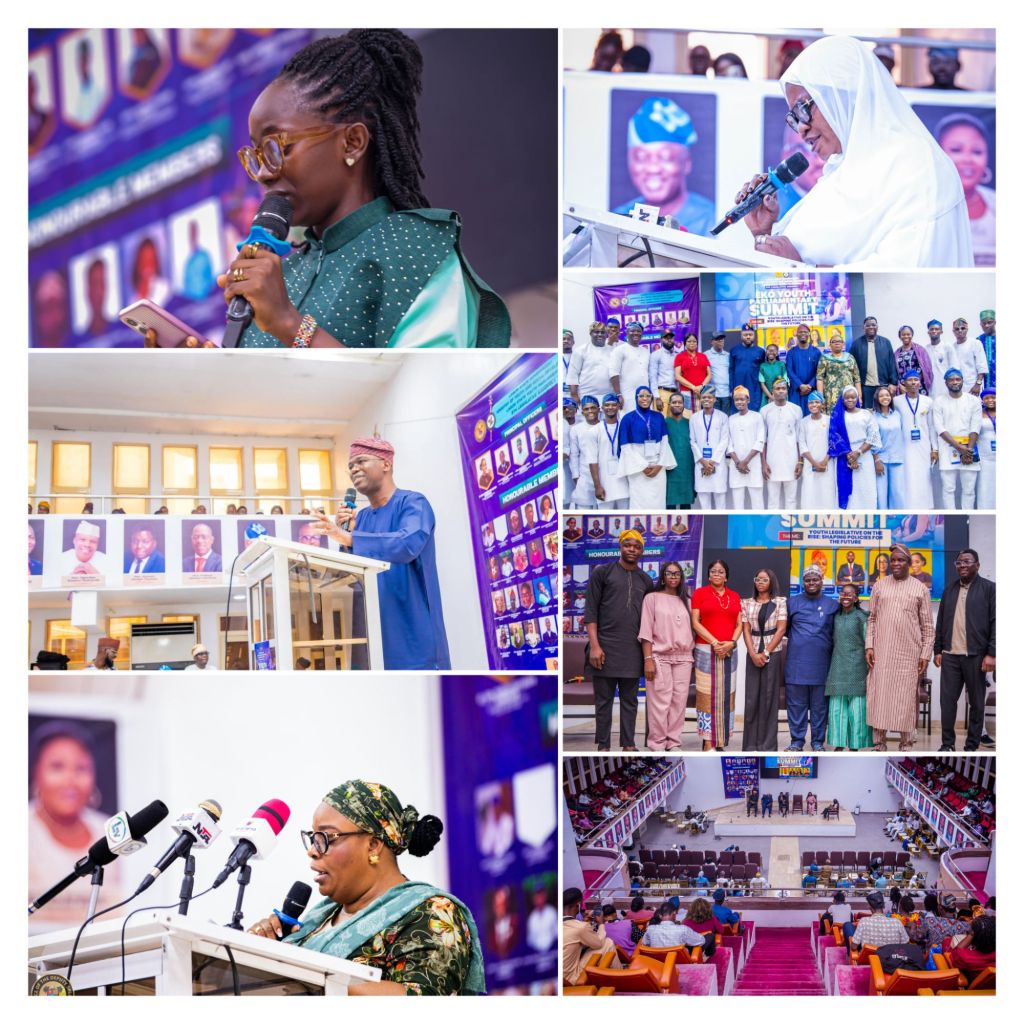
The 5th Assembly of the Lagos State Youth Parliament has held its maiden Eko Youth Parliamentary Summit, marking a major milestone in youth legislative engagement in the state.
Speaker of the Assembly, Itunuoluwa Maria Soniregun, described the summit as a declaration that the voices of Lagos youths are now actively shaping governance.
She noted that the Parliament has executed over 100 projects addressing skills development, gender inequality, climate action and digital literacy, while strengthening international partnerships that position Lagos youths on the global stage.
Soniregun commended the administration of Governor Babajide Olusola Sanwo-Olu, the Ministry of Youth and Social Development led by Hon. Mobolaji Ogunlende, and the leadership of the Lagos State House of Assembly under Speaker Mudashiru Obasa for their consistent support.
She said the Youth Parliament, modeled after the state legislature and coordinated by the ministry, has produced members who are now serving in executive and legislative capacities at both state and national levels.
She explained that the summit was convened to deepen youths’ understanding of legislative processes, stressing that while many young people understand the executive arm, the legislature remains less understood despite its critical role in lawmaking and oversight.
Senator Tokunbo Abiru, representing Lagos East Senatorial District in his Keynote address commended the Lagos State Government for sustaining a visionary platform that models the Youth Parliament after the Lagos State House of Assembly and gives our youths real legislative exposure.
Speaking on the theme, “Youth Legislature on the Rise: Shaping Policies for the Future,” he reminded the audience that influence in the 21st century is driven by ideas, innovation and impact. He added that lasting change requires structure, discipline and sound legislative engagement.
He reaffirmed his commitment to youth development through three pillars: Legislative Responsibility, Empowerment, and Endowment. From advancing strategic bills and motions at the National Assembly, to supporting scholarships, healthcare, infrastructure and enterprise, our focus remains clear; policies must translate into practical impact.
He also highlighted the work of the SAIL Innovation Lab, which has empowered over 10,000 young people with digital and tech skills, creating jobs and nurturing job creators across Lagos East.
He urged the youth to engage constructively in governance, support reforms that promote stability and opportunity, and prepare themselves for leadership with competence, character and collaboration. The future belongs to prepared minds.
Rt. Hon. Mojisola Meranda, Deputy Speaker Lagos State House of Assembly described Nigeria’s youthful population as both a demographic advantage and a policy responsibility. She noted that over 60 percent of Nigeria’s population is under the age of 30, while more than 70 percent falls within the broader youth category of 15–35 years.
Despite this numerical strength, she observed that youth representation in legislative chambers remains significantly low, with young lawmakers occupying only single-digit or minimal percentages in many assemblies. She further pointed out that although youths formed the largest segment of registered voters in the 2023 general elections, this has not translated into proportional representation.
The Deputy Speaker identified key barriers to youth civic engagement, including structural underrepresentation, limited access to government empowerment programmes, weak engagement with elected officials, and widespread apathy and mistrust in formal political processes.
She acknowledged the impact of youth-led advocacy movements such as the Not Too Young To Run campaign, which successfully lowered age requirements for public office and expanded political opportunities for young Nigerians.
Meranda urged young people to embrace civic literacy, understand legislative procedures, and actively participate in policymaking. She advocated for institutionalized youth platforms such as youth parliaments, legislative internships, mentorship programmes, and youth-centred policy committees within legislative houses.
Describing youths as the largest voting bloc and the most digitally connected generation, she encouraged them to see the summit as a springboard for concrete action rather than mere dialogue, emphasizing that the future of governance depends on their active involvement.
Chairman House Committee on Youth, Sports and Social Development, Hon. Abiodun Orekoya, described Lagos as Nigeria’s economic and innovation hub, stressing that with a significant percentage of the population under 35, youth participation must move beyond symbolism to structural involvement in policymaking.
He urged young people to transition from advocacy to active engagement in lawmaking, policy development and institutional leadership, while advocating stronger leadership development platforms, civic education and mentorship structures.
He also commended President Bola Ahmed Tinubu and Governor Babajide Sanwo-Olu for youth-focused reforms under the Renewed Hope Agenda.
Permanent Secretary, Lagos Ministry of Youth and Social Development, Pharm. Toyin Oke-Osanyintolu, noted that over 60 percent of Lagos residents are youths aged 15 to 35, describing the summit as a strategic platform to deepen understanding of legislative procedures and strengthen democratic participation.
Deputy Majority Leader of the Lagos State House of Assembly, Hon. Richard Adedamola Kasunmu, encouraged the 5th Lagos Youth Parliament to build knowledge and capacity early, saying the next generation must be prepared intellectually and morally to lead Nigeria into global competitiveness.
Speaking on the role of legislators,
Hon. Abiodun Tobun said parliamentarians must create enabling environments through lawmaking, motions and people-focused bills. He emphasized the critical duties of appropriation and oversight, noting that lawmakers must engage constituents to understand their priorities, ensure their needs are reflected in the budget, and monitor project implementation to guarantee accountability.
He added that parliament remains central to governance because it legislates, appropriates funds and checks the executive.
Hon. Oladipupo Ajomale stressed that effective representation begins with listening. He said lawmakers in Lagos prioritize feedback from constituents and translate public concerns into action.
He urged youths to remain politically active and informed, adding that national reforms are opening Nigeria to greater economic opportunities and investment.
The Mayoress of Ikosi-Isheri LCDA, Princess Samiat Bada, charged members of the Youth Parliament and other young people to stop referring to themselves as leaders of tomorrow, but rather as leaders of today.
Princess Bada emphasized that the future begins now, urging young people to take immediate responsibility for governance, community development and nation-building. She encouraged them to embrace leadership roles with confidence, commitment and a sense of urgency.
According to her, youths must position themselves as active contributors to society, noting that meaningful change can only occur when young people recognize their present capacity to influence decisions and shape the direction of their communities.
Lagos APC Youth Leader, Dr. Muritala Seriki, described the youth parliament initiative as evidence that the state government is taking deliberate steps toward youth development.
He commended the 5th Assembly for its progress and encouraged sustained engagement, noting that structured youth participation strengthens democratic institutions and prepares future leaders.
Participants were urged to embrace knowledge, build networks and see leadership as a responsibility, as the Assembly reaffirmed its commitment to preparing a generation of informed and governance-ready young leaders.
 ajasainfo.com
Leave a Reply