
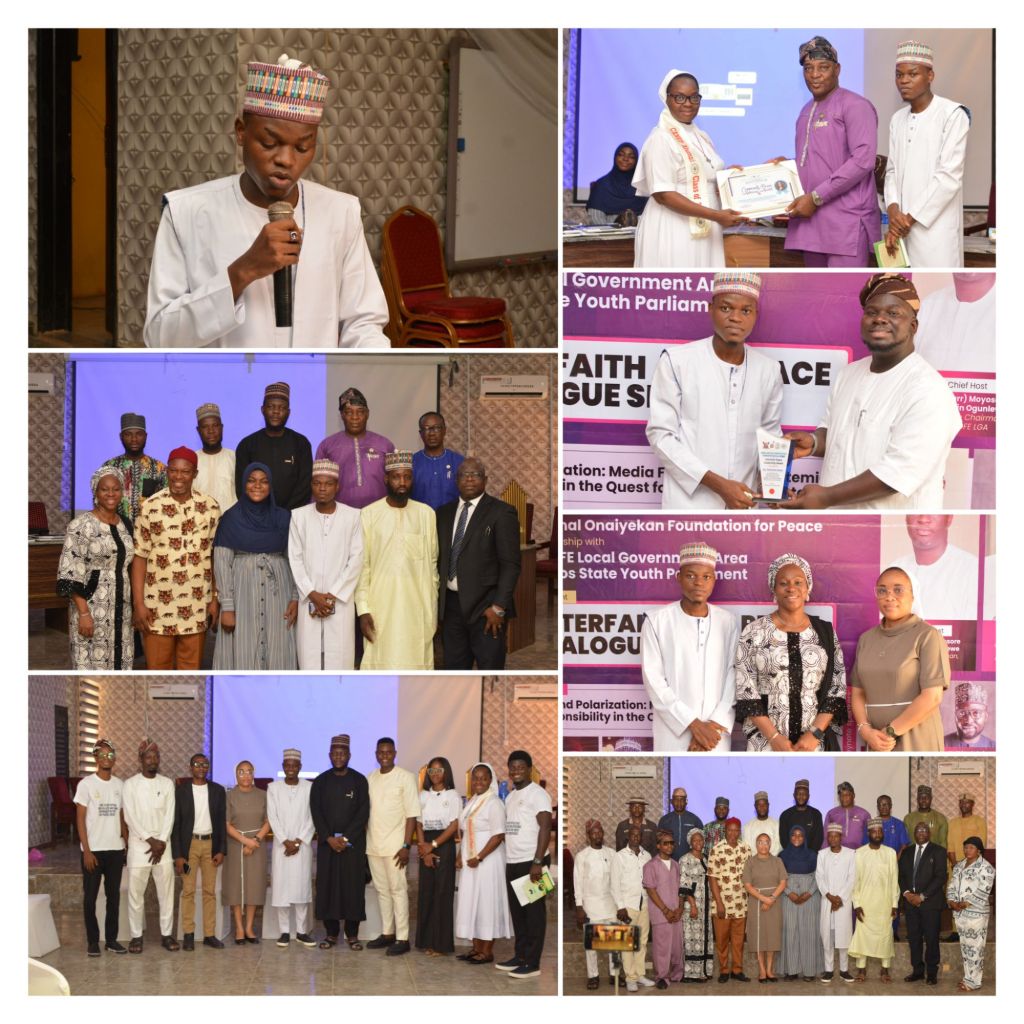
Youth leaders, religious figures, and peace advocates converged in Kosofe, Lagos State, for an Interfaith and Peace Dialogue Seminar aimed at promoting religious tolerance, countering misinformation, and strengthening peaceful coexistence among young people.
Delivering the opening remarks, the convener of the seminar, Habeebullah Arayemi, emphasized the urgent need for dialogue in the face of rising religious misunderstandings and media-driven misinformation across the country. Arayemi, a Fellow of the Cardinal Onaiyekan Foundation and Youth Representative of Kosofe Constituency 01 at the Lagos State Youth Parliament, described the gathering as timely, noting Nigeria’s continued struggles with the consequences of intolerance and distorted narratives.
He recalled past and present religious tensions in parts of the country, including Kaduna, Jos, the North-East, and even pockets within Lagos, stressing that such conflicts often stem from fear, falsehoods, and the deliberate misrepresentation of faith rather than religion itself.
A major focus of the seminar was the danger of media fallacies in the digital age. Arayemi warned that manipulated headlines, misleading videos, and inflammatory social media posts could incite violence within minutes if consumed uncritically. He urged youths to be more responsible online, particularly as active users and influencers on digital platforms.
Quoting Cardinal John Onaiyekan, Arayemi reminded participants that religion should serve as “a bridge for dialogue and peace, not an excuse for violence,” adding that young people must refuse to become tools of division through careless sharing of unverified information.
He charged participants to verify information before sharing, reject hate speech even when cloaked in religious sentiment, speak out against the misuse of faith to justify violence, and model peaceful coexistence in their daily lives.
Addressing the youths in attendance, he urged them to choose dialogue over disagreement, understanding over assumption, and peace over provocation, calling on Kosofe to become a model of interfaith harmony in Lagos State.
The Permanent Secretary, Lagos State Ministry of Youth and Social Development, Pharm. Toyin Oke-Osanyintolu, stressed the importance of intentional peacebuilding, ethical media practice, and youth leadership in addressing growing societal divisions.
Commending participants for their commitment to promoting dialogue at a time when societies, both locally and globally, are grappling with deepening polarization.
Oke-Osanyintolu expressed appreciation to the Foundation for Peace for its consistent efforts in advancing peacebuilding, religious harmony, and ethical leadership, noting that peace does not occur by accident but must be deliberately nurtured through dialogue, education, and shared responsibility.
She described the theme of the seminar—focusing on polarization, media fallacies, and epistemic responsibility in the quest for peaceful coexistence—as timely and profound.
According to her, the rapid spread of information in the digital age has outpaced reflection, allowing opinions to frequently replace facts and enabling social media to either unite communities or dangerously divide them.
The Permanent Secretary identified polarization as one of the defining challenges of modern society, fueled by misinformation, biased narratives, and misunderstanding. She noted that in a diverse society like Lagos, home to people of different faiths, cultures, and ethnic backgrounds, peaceful coexistence is not merely a moral ideal but a necessity for sustainable development.
She further explained that while diversity remains a source of strength, it can become a flashpoint for conflict when poorly managed or deliberately misrepresented. Emphasizing the influence of both traditional and digital media, she noted that the media has the power to educate, inform, and promote unity, but also the potential to amplify falsehoods if not guided by ethical standards and epistemic responsibility.
Oke-Osanyintolu defined epistemic responsibility as the obligation to seek truth, verify information, and communicate responsibly, especially on sensitive issues such as religion, identity, and communal relations.
She clarified that peacebuilding is not the responsibility of the media alone but a collective duty involving parents, religious leaders, media practitioners, and youths. She described young people as not only the leaders of tomorrow but the leaders of today, given their active role as consumers and creators of media content.
Highlighting the role of the Ministry of Youth and Social Development, she stated that the ministry’s policies and programmes are designed to empower youths with critical thinking skills, media literacy, ethical values, and civic consciousness, enabling them to resist manipulation and embrace dialogue over division.
Mr. Abass Agbaje, Keynote Speaker at the Interfaith and Peace Dialogue Seminar, has called on youths and media consumers to reject polarization, question unverified narratives, and embrace responsibility in the pursuit and use of knowledge.
In his address, Agbaje commended the convener for his energy and youthful leadership, describing it as a vital force for peacebuilding in a divided society. He noted that polarization—whether religious, social, or ideological—raises fundamental questions about why humans choose division over unity.
He explained the concept of media fallacies, describing them as statements presented as facts but lacking evidence and logical grounding. According to him, such claims often sound convincing yet cannot be verified, making them dangerous tools for misinformation and conflict.
Using familiar examples, Agbaje illustrated how unverifiable stories—particularly those passed through word of mouth or social media—can easily polarize communities when accepted without scrutiny. He stressed that any claim unsupported by concrete evidence remains a fallacy and should be treated with caution.
The keynote speaker introduced participants to the concept of epistemic responsibility, drawn from epistemology, the study of knowledge. He explained that beyond knowing, individuals have a duty to actively seek truth, distinguish right from wrong, and apply knowledge responsibly toward positive outcomes.
Agbaje further emphasized that education is meant to bring internal transformation that reflects in action, not just intellectual advancement. He questioned the value of human progress if society still struggles to live in harmony despite advances in science, humanities, and social sciences.
Speaking at the event, Mrs. Rashidat Umar, Director at the Lagos State Ministry of Youth, described the dialogue as a commendable initiative that brings people together across religious lines. She expressed pride in Lagos’ long-standing culture of tolerance, noting that residents of the state traditionally coexist peacefully regardless of faith.
She urged participants to continue promoting love and acceptance, emphasizing that discrimination has no place in a society built on shared humanity and mutual respect.
Comrade Teslim Olusi, Senior Special Assistant to the Governor on Home Affairs, has called on religious leaders across the state to promote peaceful coexistence and mutual tolerance among adherents of different faiths. He urged clerics to encourage harmony at their various places of worship, avoid condemning other religions, and embrace understanding and respect as key tools for sustaining peace and unity within communities.
In his remarks, the Chairman of the Christian Association of Nigeria (CAN), Kosofe Local Government, Rev. Remi Mathew Adejumo, commended the convener for organizing the dialogue and addressing the dangers of polarization.
He noted that differences in belief are a natural part of human existence and should serve to complement society rather than create competition or conflict.
Rev. Adejuwon explained that diversity in thought, faith, and perspective exists even among people of the same family and should not be used as a basis for hatred or violence.
Reflecting on the shared historical roots of major religions, he observed that Christianity, Islam, and traditional beliefs trace their origins to common ancestral foundations, underscoring the interconnectedness of faiths.
Drawing from his experiences visiting Jerusalem, he highlighted how people of different religions coexist in the same geographical space, arguing that peaceful living across faiths is both possible and practical.
He further warned that misinformation, malinformation, and the failure of leaders to promote truth have contributed significantly to religious tension and violence. According to him, religion should guide individuals’ values and actions, not define or divide them.
Also speaking, Chief Kelvin, the Leader of the Ndigbo Community in Kosofe Local Government, called on participants to see one another first as human beings, insisting that humanity must take precedence over religion or ethnic identity.
The seminar concluded with a call for sustained commitment beyond discussions, urging participants to reflect the principles of peace in their words, actions, online engagements, and leadership roles.
 ajasainfo.com
Leave a Reply