
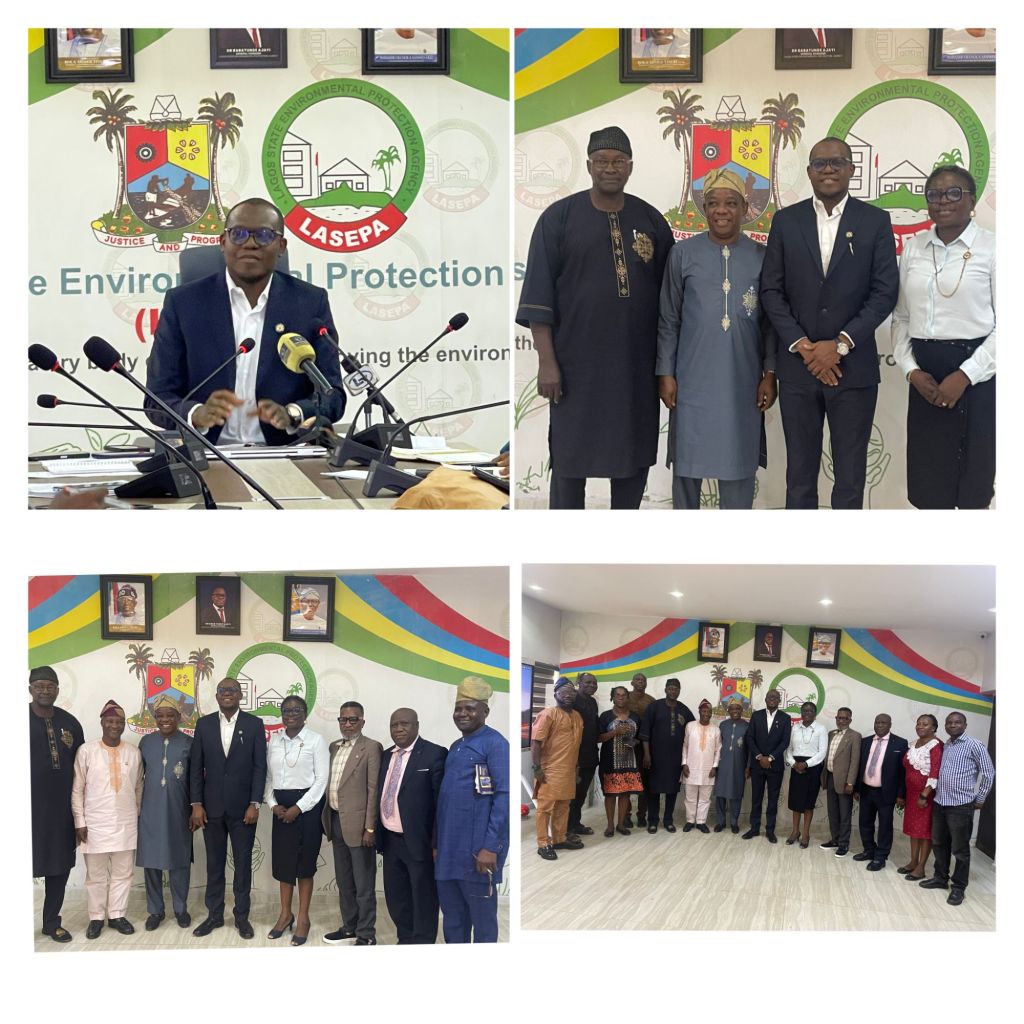
The Lagos State Environmental Protection Agency (LASEPA) convened its Annual Performance Appraisal and Media Parley, with the General Manager, Dr. Babatunde Ajayi, engaging media representatives and key stakeholders. The session focused on reviewing the agency’s performance in 2025 and outlining strategic priorities for 2026.
Speaking at the parley, Dr. Ajayi described 2025 as a landmark year for LASEPA, noting that virtually all departments recorded major milestones. He emphasized that it would be impossible to tell the environmental story of Lagos State without recognizing LASEPA’s central role in driving city-wide environmental advocacy and enforcement.
According to him, effective communication is essential not only for visibility but also to ensure information reaches the public, encouraging greater engagement.
Dr. Ajayi highlighted the pivotal role of the media in environmental governance, describing communication as a critical tool in driving behavioural change. He explained that the platform was deliberately created to provide a comprehensive recap of the Agency’s activities in 2025, while also sharing plans and expectations for 2026. “Setting clear goals makes it easier to measure performance at the end of the year,” he added.
The General Manager underscored enforcement as a core pillar of LASEPA’s mandate, noting that law and order remain central to the Ministry of the Environment’s responsibilities. He disclosed that the Agency carried out 244 enforcement actions across Lagos State, covering religious centres, hospitality establishments, warehouses, markets, hotels, and residential households. “Many residents often overlook the environmental responsibilities of households, but LASEPA ensures applicable regulations are enforced where violations are identified,” he said.
On industrial monitoring and compliance, Dr. Ajayi revealed that the Agency intensified oversight of critical sectors, with special focus on the Ojota Chemical Market, one of Lagos’ largest chemical markets. He explained that regulating chemical handling is a strategic approach to curbing food fraud and other environmental and public health risks.
LASEPA, in collaboration with the National Environmental Standards and Regulations Enforcement Agency (NESREA), ensured that chemical handlers were properly registered and compliant with safety guidelines, preventing illegal access to chemicals that could be used in producing harmful products. “Protecting public health remains our top priority,” he added.
Addressing electronic waste and lead-acid battery management, Dr. Ajayi recalled the widely publicized lead poisoning incident in Ogijo community earlier in the year. He noted that Lagos State had proactively addressed similar risks by relocating improperly operated lead-acid recycling facilities. Currently, only licensed collectors are allowed to operate under strict regulation, significantly strengthening control over hazardous waste management.
The General Manager disclosed that in 2025, LASEPA received 8,437 complaints across various environmental categories, with noise pollution accounting for approximately 3,300 complaints, or roughly one-third of all reports. He explained that the Agency adopts a graduated enforcement approach, often issuing first and second warnings before sealing facilities.
Many violators, he noted, comply after initial engagement, reducing the need for harsher measures.
Dr. Ajayi also highlighted LASEPA’s community-based interventions, citing the introduction of smokeless fish kilns in the Ago-Egun, Ilaje–Bariga fishing community as a major success. Continuous fish smoking had previously resulted in poor air quality, affecting the health and productivity of women and children. The modern smokeless kilns improved efficiency, reduced emissions, enhanced food safety, and increased income by expanding production capacity. Two kilns were deployed in 2025, with plans to introduce four or five more in 2026, depending on assessed community needs and partnerships with private sector players through corporate social responsibility initiatives.
On public health interventions, Dr. Ajayi explained that LASEPA collaborated with the Lagos State Ministry of Health and other stakeholders to collect water samples, test water quality, interpret results, and treat water sources, supporting early detection and prevention of cholera outbreaks.
He further disclosed that under the LASEPA–UNIDO cholera prevention initiative, funded by a ¥225,000 grant from the Government of Japan through UNIDO, the Agency distributed 223 food and water vendor kits across 12 markets, benefiting 770 participants in targeted local government areas, including Ikorodu, Lagos Island, Lagos Mainland, Alimosho, Ojo, and Kosofe.
Dr. Ajayi also emphasized LASEPA’s strides in air quality management, noting collaborations with the Air Quality Monitoring Research Group (AQMRG), UNILAG, and AirQo of the University of Makerere, as well as partnerships with C40 African Cities under the AC4A Initiative. These efforts enabled the deployment of low-cost air quality sensors across Lagos, the development of a greenhouse gas and air quality emissions inventory, health impact analyses, and continuous monitoring. The Agency successfully completed 114 sensor installations, including 32 AirQo units, 18 Airly units, 55 MIRI sensors, two AQMesh sensors, one Kunak sensor, and six Clarity sensors.
Dr. Ajayi concluded by reaffirming LASEPA’s commitment to prioritizing public health, environmental sustainability, and the protection of lives and livelihoods of Lagos residents. He also emphasized strengthening collaboration with the media and stakeholders to achieve a cleaner, healthier, and more resilient Lagos in 2026.
 ajasainfo.com
Leave a Reply