
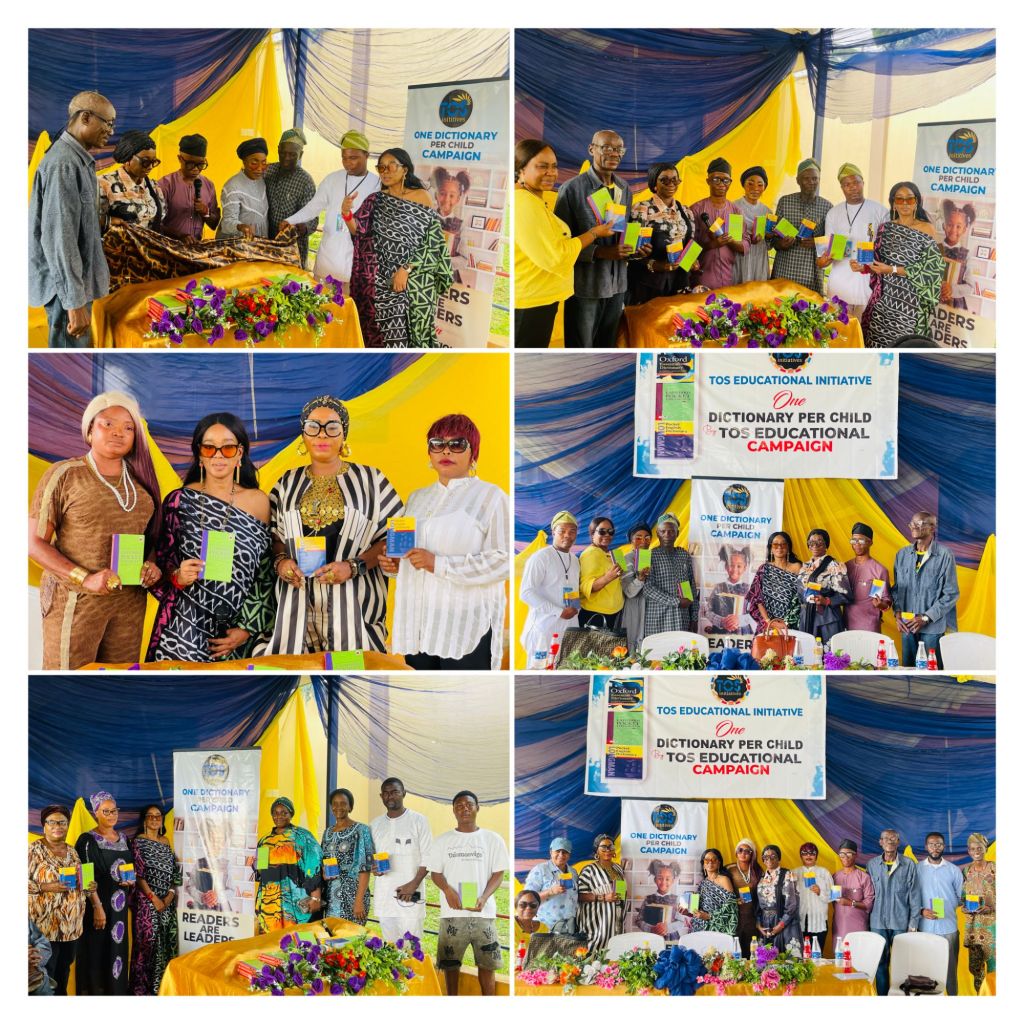
The TOS Educational Initiative has introduced a new campaign aimed at improving literacy and communication skills among schoolchildren across Lagos State. The programme, known as “One Dictionary Per Child,” is designed to give each student a personal dictionary to support learning and build confidence.
According to the initiative’s convener, Taiwo Ololade Salvador, the project grew out of years of reviewing how students participate in various educational programmes. During these evaluations, the team discovered that many students struggled to fully engage because they lacked a simple tool that could help them understand new words and express themselves clearly. The dictionary, she explained, serves as a practical solution by helping students break down unfamiliar terms and communicate without fear.
Salvador noted that many children in underserved communities cannot rely on smartphones for learning due to issues such as theft, lack of data, irregular electricity supply, and the inability of some parents to afford Android devices. She emphasised that a physical dictionary is safer, more dependable, and always accessible. Children can keep it in their pockets without worrying about losing an expensive item or depending on internet connectivity.
While acknowledging ongoing government efforts to expand technology in schools—particularly initiatives led by the Lagos State Government and the Federal Ministry of Education—Salvador insisted that digital tools cannot replace the reliability of a printed dictionary. She stated that the initiative intends to distribute dictionaries across the 20 Local Government Areas in Lagos starting January, before extending to all 37 Local Council Development Areas (LCDAs).
The organisation is calling on political officeholders and community leaders—from senators and House of Representatives members to state legislators and local government chairmen—to support the project by matching and expanding its efforts. Salvador described the initiative as a long-term investment in the educational future of Lagos children, rather than a ceremonial or one-off project.
She also stressed that improving education requires collective effort. Community groups, market women, artisans, transport unions, and local associations are being encouraged to contribute by sponsoring dictionaries for children in their neighbourhoods. According to the initiative, even one dictionary in the hands of a child can have a long-lasting impact, potentially shaping future leaders who will emerge from these communities.
Chief Tunde Fanimokun, represented by Mr. Francis, commended TOS Educational Initiative for what he called a laudable and necessary intervention.
He noted that children must understand the words they speak and that a dictionary remains one of the most effective tools for building vocabulary and boosting communication skills. He further encouraged parents and teachers to embrace the initiative for the long-term benefit of young learners.
Also speaking, Comrade Alaba Israel of the APC Progressive Teachers Congress described the project as “the first of its kind” since his years in the teaching profession. He said the impact of providing dictionaries goes beyond the present moment, adding that it empowers both the immediate learning experience and the future potential of every child who receives one.
The Chairman of the Central Parents Forum, Mr. Wasiu Owoyemi, stressed that every child should learn at least one new word daily, making dictionaries essential tools for continuous learning. He urged parents to take advantage of the initiative to instill regular reading habits in their children.
In her remarks, Mrs. Alli Balogun encouraged mothers to motivate their children to use dictionaries more frequently. She also called on community members to support the founder of the programme, Taiwo Ololade Salvador, so that the initiative can reach even more children across various communities. She urged parents to guide their children, especially in the areas of dressing and avoidance of social vices.
Similarly, Mrs. Olayinka emphasized that beyond providing dictionaries, parents and guardians should focus on instilling strong morals in their children. She expressed concern about the rising involvement of youths in questionable activities and encouraged adults to monitor and educate them consistently. Pledging her personal support, she announced that at the next gathering she would bring produce from her farm to sell, with proceeds donated to further the dictionary project.
Representing the Chairman of Eti-Osa Local Government, Mojisola Olemoh described the initiative as commendable and essential in today’s digital age. She explained that while many children rely on internet searches, online platforms often expose them to unsuitable content.
A physical dictionary, she noted, allows children to learn safely, build knowledge and avoid distractions. She urged young learners to use the dictionary as a tool to enlighten themselves and to work toward a brighter future.
The event concluded with a renewed call for collective responsibility, with stakeholders emphasizing that improving literacy requires the joint effort of parents, teachers, community members and Government representatives.
The campaign aims to ensure that every child, regardless of background, has access to a foundational learning tool that can support their academic journey and boost their confidence for years to come.
 ajasainfo.com
Leave a Reply